Dr. Carolyn Mukai, ND, Dr. Lynn Klassen, ND, Dr. Ece Toprak, ND
Increasing recognition of infection-triggered neuroinflammation in kids, adolescents, and adults—and the evolving function of integrative immune regulation.
Summary:
This medical commentary examines the increasing understanding of Pediatric Acute-Onset Neuropsychiatric Syndrome (PANS) and PANDAS as a part of a broader spectrum of post-infectious neuroimmune syndromes. It opinions infectious triggers, immune mechanisms, autonomic and systemic options, and integrative administration methods whereas emphasizing the necessity to acknowledge these patterns past childhood.
Introduction: When An infection and Psychiatry Intersect
Pediatric Acute-Onset Neuropsychiatric Syndrome (PANS) and Pediatric Autoimmune Neuropsychiatric Problems Related to Streptococcal infections (PANDAS) sit at a crossroads acquainted to naturopathic clinicians: an infection, immune dysregulation, neuroinflammation, and psychological well being. These circumstances problem the standard separation between psychiatric and medical sickness and spotlight how immune activation following an infection can abruptly reshape cognition, habits, and emotional regulation.1-5
There’s a rising physique of medical proof that emphasizes the necessity for an integrative method to those circumstances. PANS and PANDAS supply a transparent instance of post-infectious syndromes, paralleling rising fashions seen in lengthy COVID and autoimmune neurologic illness.4, 5 Though classically described in pediatric populations, growing proof means that related post-infectious neuropsychiatric displays can happen in adolescents and adults, underscoring the significance of recognizing this sample throughout the lifespan.6-8
A Baby Who Adjustments In a single day
An eight-year-old little one presents with sudden onset of tics, compulsive handwashing, separation anxiousness, nightly rage episodes, and refusal to eat perceived unsafe meals. Inside days, new bedwetting and profound insomnia seem. 4 weeks earlier, the kid had a febrile sore throat handled at house.
Subsequent analysis reveals current streptococcal publicity. Over the next months, signs flared with viral diseases and sinus infections.
Infections as Triggers
The vignette above describes the traditional medical historical past and neuroimmune signs seen in PANDAS. Group A Streptococcus stays the best-studied set off for PANDAS particularly, with symptom flares typically following pharyngitis and partial response to antibiotics.2,4 Nonetheless, this slim definition has needed to shift considerably since its inception attributable to growing circumstances of comparable, abrupt-onset neuropsychiatric syndromes with out clear associations with streptococcal infections and onset extending into adolescence and maturity. 1, 4-6
PANS is now the bigger umbrella prognosis that envelops PANDAS whereas broadening the panorama to incorporate different attainable inciting infections like Mycoplasma pneumoniae, Epstein-Barr virus, different viral/bacterial higher respiratory infections, Borrelia burgdorferi, and extra just lately COVID-19.4, 5
Analysis remains to be growing on this space, and it’s doubtless that there are a lot of different infectious triggers – particularly infections that are likely to go undiagnosed like Bartonella species an infection and different vector borne diseases. Bartonella species, in addition to Borrelia species, are significantly indicated in infection-immune mediated neuropsychiatric signs all through the lifespan that may overlap considerably with PANS.6-12
PANS diagnostic frameworks have additionally developed to think about non-infectious triggers that will synergize with infections, together with pre-existing immune problems (autoimmunity, allergic/atopic illness), environmental exposures (for instance, mould/mycotoxins in medical observe) and psychosocial or physiologic trauma.1,4,5
Fairly than a single‑pathogen syndrome confined to pre‑pubescent kids, PANS is best conceptualized as a multi‑set off immune vulnerability framework with out strict age limits for prognosis.1,4,5 The removing of the age restriction in characterizing these circumstances is important – as there are at the moment no properly‑established, analogous fashions for an infection mediated neuropsychiatric displays in adolescents and adults, that are subsequently at greater danger of misdiagnosis as major psychiatric problems.5-8
Rising information means that related publish‑infectious neuroimmune phenomena could lengthen into adolescence and maturity. Case experiences and cohort research now hyperlink vector‑borne infections resembling Bartonella species and Lyme‑related pathogens with persistent neuropsychiatric signs, together with psychosis, temper modifications, cognitive decline, and PANS‑like displays in older sufferers.6-12 These findings, whereas preliminary, assist viewing PANS and associated publish‑infectious neuroimmune syndromes alongside a lifespan continuum moderately than as strictly pediatric circumstances.5-8, 12
From An infection to Neuroinflammation
Proposed mechanisms in PANS embrace immune cross-reactivity between infectious and neuronal antigens (molecular mimicry) and the event of neuronal autoantibodies.3-5 Different described mechanisms embrace Th17 pushed pro-inflammatory cytokine elevation, blood mind barrier disruption, microglial activation, and a shift in the direction of pro-inflammatory innate immune responses.3-5 These immune processes are thought to have an effect on dopaminergic signaling and basal ganglia circuits concerned in habits and emotion regulation.3-5 This mannequin helps clarify the vast spectrum of signs seen in PANS, together with extra overt neurologic modifications like irregular motion patterns (for instance Sydenham chorea, additionally related to streptococcal an infection) and developmental regression in speech and handwriting.3-5 Neurodivergent traits are additionally frequent on this affected person subset and will wax and wane with different neuroinflammatory signs.5
Different distinguished signs could embrace abrupt consuming restriction, sensory hypersensitivity, complications, ache, insomnia, fatigue, cognitive dysfunction, and urinary disturbances. These systemic options distinguish PANS from major psychiatric problems and replicate widespread irritation and autonomic dysfunction.1,4,5
Medical Administration Issues
Skilled consensus helps focused antimicrobial remedy when an infection is clearly recognized in PANDAS displays. For PANS, tips suggest an intensive an infection publicity and household medical historical past with extra testing and therapy for well-characterized infectious and immune contributors.1-3
On the similar time, knowledgeable opinions diverge on empiric antimicrobial remedy and on how broadly to display screen for infections past normal diagnostic work‑ups for identified triggers.
In our medical expertise, and primarily based on rising proof, an in depth publicity and an infection historical past is important, and routine consideration of vector‑borne and related infections (for instance, Lyme illness and co‑infections) is warranted in acceptable epidemiologic contexts, significantly given the growing prevalence of ticks and different vectors.6-8, 12,13
Immunotherapy is the frequent denominator in an integrative therapy method as infections and different immune insults (for instance, allergic phenomena, mast cell activation syndrome, environmental exposures) are addressed. 1-3, 5 Quick programs of NSAIDs could scale back symptom burden with out the diploma of immune suppression related to corticosteroids – an interesting choice when persistent or persisting an infection is suspected, although this stays controversial.3,13 Low dose naltrexone is one other potential instrument with theoretical information to assist its neurologic immunomodulatory exercise and with a positive security profile in kids and adults regardless of missing particular information in PANS or PANDAS. 13-15 Different immunomodulatory therapies resembling corticosteroids and IVIG are additionally utilized in choose circumstances and could also be particularly thought-about after treating identifiable infections and exposures.1-3
Extra integrative methods deal with supporting immune regulation, blood mind barrier integrity, microbiome well being, dietary optimization, sleep restoration, and nervous system stabilization.1,4,5
Case Instance – Tying It All Collectively
An 8‑12 months‑previous feminine introduced with a two‑12 months historical past of abrupt, multi‑system signs: persistent ache, dysarthria, anxiousness/panic, developmental regression (speech, handwriting, oppositional habits), sensory hypersensitivity, self‑stimulatory behaviors, tremor, irregular gait, sleep disturbance, palpitations, and lymphadenopathy. Signs constantly improved with ibuprofen. She had a previous tick chunk (handled briefly, normal Lyme serology destructive) and recurrent respiratory/ENT signs.
Hospital neurology and rheumatology workup was largely unrevealing other than low neutrophils, low C3, elevated TSH with regular T4, CMV IgG positivity, and sinus bradycardia. She was recognized with practical neurologic dysfunction/psychosomatic signs after main structural pathology was excluded through typical lab testing (regardless of abnormalities). Personal testing later confirmed weak T‑cell responses to Borrelia burgdorferi and Mycoplasma pneumoniae.
In our clinic, expanded infectious and metabolic testing revealed optimistic Borrelia IgG, indeterminate Bartonella serology, sturdy T‑cell response to latent CMV, and natural acid patterns suggesting yeast overgrowth, mitochondrial dysfunction, and altered neurotransmitter metabolism through personal labs. With out clear OCD or meals restrictions, technically this affected person didn’t meet the factors for PANS prognosis, broadening the differential prognosis.
We adopted a working prognosis of PANS/autoimmune encephalitis with basal ganglia involvement within the context of suspected persistent/previous tick‑borne an infection, latent viral immune activation, and attainable yeast/fungal dysbiosis. Remedy included staged neuro‑anti‑inflammatory and foundational assist (omega‑3s, quercetin/vitamin C, mitochondrial and mineral assist, cautious drainage/binders) adopted by azithromycin plus cefuroxime and nystatin. This produced partial however significant enchancment in ache and neurologic signs, with close to‑decision after extra conventional plant‑medication care through exterior practitioner. Two years later, following a viral sickness, she relapsed with migrating joint ache and sleep disturbance/fatigue; restarting mitochondrial and natural neuro‑anti‑inflammatory assist plus an preliminary trial with low‑dose naltrexone led to improved ache, sleep, and temper.
The Naturopathic Function
Though mechanistic understanding of PANS has progressed, there are nonetheless no well-validated laboratory markers to verify the prognosis. Clinicians should rely closely on historical past and medical presentation, and since psychiatric signs typically dominate, many kids and adolescents are given major psychiatric or behavioral diagnoses. 1,4-6
That is regardless of concurrent, and really tangible, neurologic and systemic findings. These signs could then be thought-about psychosomatic signs or extra broadly recognized as a practical neurologic dysfunction.
Sufferers and their households typically search second opinions at this stage – which is when you find yourself almost definitely to come across them in naturopathic observe. These different labels sometimes don’t replicate the abrupt onset, multi‑system involvement, or the lived expertise of sufferers and caregivers grappling with neuroimmune illness.
Naturopathic clinicians are uniquely positioned to acknowledge these sufferers early through the use of an entire‑particular person, sample‑primarily based method moderately than siloed organ methods and with out age bias from diagnostic algorithms. After getting seen this sample, it turns into troublesome to miss in future circumstances. We’re additionally properly positioned to assume past conventionally acknowledged triggers, together with contemplating extra infectious drivers (particularly tick‑ and vector‑borne infections with extra delicate testing) that will contribute to persistent neuroimmune activation.
Medical Pearls
- Sudden-onset neuropsychiatric signs – particularly obsession-compulsion, extreme meals restriction, behavioral modifications, or tics accompanied by systemic signs – ought to immediate an intensive immune and an infection historical past.
- Systemic options could embrace irregular actions, developmental regression in speech or writing, ache, fatigue, urinary frequency/incontinence, insomnia, and neurodivergent traits
- Infectious and non-infectious components (autoimmunity, atopy, environmental exposures, psychosocial stress) can act together to drive neuroimmune dysfunction underlying PANS/PANDAS
- Early recognition can enhance outcomes – particularly in circumstances with clear temporal associations with an infection or exposures
- Core administration is twofold: figuring out + treating contributing triggers whereas implementing immune-modulating and anti inflammatory methods.• Whereas classically described in pediatrics, PANS diagnostic standards don’t embrace strict age cut-offs and related publish‑infectious neuroimmune displays can emerge in adolescents and adults.
- Take into account that extra infectious triggers and protracted infections could current as PANS – or as broader publish‑infectious, immune‑mediated neuropsychiatric syndromes – that doubtless stay underrecognized from adolescence into maturity
Diagnostic Standards – PANS vs. PANDAS:
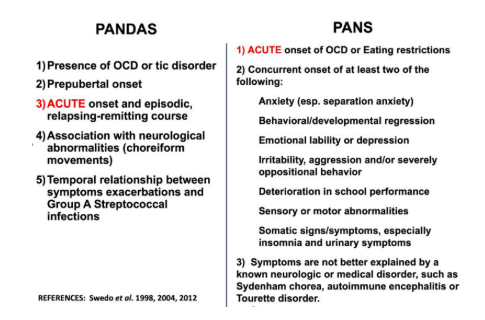
Swedo S, Menendez CM, Cunningham MW. Pediatric Autoimmune Neuropsychiatric Problems Related to Streptococcal Infections (PANDAS) 2024 Jul 7 [Updated 2024 Sep 13]. In: Ferretti JJ, Stevens DL, Fischetti VA, editors. Streptococcus pyogenes: Primary Biology to Medical Manifestations [Internet]. 2nd version. Oklahoma Metropolis (OK): College of Oklahoma Well being Sciences Heart; 2022 Oct 8. Chapter 26. Out there from: https://www.ncbi.nlm.nih.gov/books/NBK607260/”
 Dr. Carolyn Mukai, ND is a licensed naturopathic doctor with specialised coaching in vector-borne sickness, persistent advanced illness, and multidisciplinary look after Lyme illness and related infections. She accomplished Canada’s first CNME-accredited residency program targeted on vector-borne sickness and persistent advanced illness at Tandem Clinic, the place she now treats sufferers utilizing individualized evaluation and integrative therapeutics. Dr. Mukai combines superior lab analysis, botanical and nutrient remedy, way of life medication, and collaborative care to research underlying contributors to persistent circumstances and assist patient-centered, root-cause therapeutic. She can be a speaker and educator on persistent an infection methods and practitioner schooling.
 Dr. Lynn Klassen, ND is a licensed naturopathic doctor and founding father of Tandem Clinic, the place she focuses on Lyme illness, persistent an infection, and sophisticated persistent sickness utilizing an integrative and systems-based medical framework. As a Lyme Literate ND (LLND), she is skilled in modern diagnostics and therapy methods for difficult infectious and autoimmune displays and has developed Canada’s first CNME-accredited naturopathic residency in vector-borne sickness and persistent advanced illness. Dr. Klassen is captivated with enhancing recognition and look after sufferers typically missed by typical methods and contributes to clinician schooling and coaching in persistent an infection administration.
 Dr. Ece Toprak, ND is a licensed naturopathic doctor and graduate of the Canadian School of Naturopathic Medication (CCNM), the place she accomplished her foundational coaching in integrative medication. Dr. Toprak is devoted to evidence-informed medical observe and has contributed to naturopathic analysis and displays throughout her educational coaching, together with student-faculty collaborations on medical subjects at CCNM. She brings a systems-based perspective to affected person care, incorporating complete evaluation, way of life medication, botanical and dietary therapeutics, and individualized therapy planning to assist advanced and multisystem well being considerations.
- American Academy of Pediatrics. Pediatric acute-onset neuropsychiatric syndrome (PANS): medical report. Pediatrics. 2025;155(3):e2024070334. doi:10.1542/peds.2024-070334.
- Swedo S, Menendez CM, Cunningham MW. Pediatric Autoimmune Neuropsychiatric Problems Related to Streptococcal Infections (PANDAS) 2024 Jul 7 [Updated 2024 Sep 13]. In: Ferretti JJ, Stevens DL, Fischetti VA, editors. Streptococcus pyogenes: Primary Biology to Medical Manifestations [Internet]. 2nd version. Oklahoma Metropolis (OK): College of Oklahoma Well being Sciences Heart; 2022 Oct 8. Chapter 26. Out there from: https://www.ncbi.nlm.nih.gov/books/NBK607260/
- Frankovich J, Swedo S, Murphy T, et al. Medical Administration of Pediatric Acute-Onset Neuropsychiatric Syndrome: Half II-Use of Immunomodulatory Therapies. J Baby Adolesc Psychopharmacol. 2017;27(7):574-593. doi:10.1089/cap.2016.0148
- Vreeland A, Calaprice D, Or-Geva N, et al. Postinfectious Irritation, Autoimmunity, and Obsessive-Compulsive Dysfunction: Sydenham Chorea, Pediatric Autoimmune Neuropsychiatric Dysfunction Related to Streptococcal An infection, and Pediatric Acute-Onset Neuropsychiatric Dysfunction. Dev Neurosci. 2023;45(6):361-374. doi:10.1159/000534261
- Gagliano A, Carta A, Tanca MG, Sotgiu S. Pediatric Acute-Onset Neuropsychiatric Syndrome: Present Views. Neuropsychiatr Dis Deal with. 2023;19:1221-1250. Printed 2023 Could 24. doi:10.2147/NDT.S362202
- Delaney S, Robveille C, Maggi RG, et al. Bartonella species bacteremia in affiliation with grownup psychosis. Entrance Psychiatry. 2024;15:1388442. Printed 2024 Jun 7. doi:10.3389/fpsyt.2024.1388442
- McDuffee NS, Steinour M, Shah Okay. Neuropsychiatric Manifestation of Tick-Borne Illness and the Significance of Screening in Endemic Areas. Prim Care Companion CNS Disord. 2025;27(4):25cr03948. Printed 2025 Aug 14. doi:10.4088/PCC.25cr03948
- Bransfield RC. The psychoimmunology of lyme/tick-borne ailments and its affiliation with neuropsychiatric signs. Open Neurol J. 2012;6:88-93. doi:10.2174/1874205X01206010088
- Lins KA, Drummond MR, Velho PENF. Cutaneous manifestations of bartonellosis. An Bras Dermatol. 2019;94(5):594-602. doi:10.1016/j.abd.2019.09.024
- Breitschwerdt EB, Greenberg R, Maggi RG, Mozayeni BR, Lewis A, Bradley JM. Bartonella henselae Bloodstream An infection in a Boy With Pediatric Acute-Onset Neuropsychiatric Syndrome. J Cent Nerv Syst Dis. 2019;11:1179573519832014. Printed 2019 Mar 18. doi:10.1177/1179573519832014
- Stewart Z, Korsapathy S, Frohlich F. Crowd-sourced investigation of a possible relationship between Bartonella-associated cutaneous lesions and neuropsychiatric signs. Entrance Psychiatry. 2023;14:1244121. Printed 2023 Oct 24. doi:10.3389/fpsyt.2023.1244121
- Cross A. Case Report: PANDAS and protracted Lyme illness with neuropsychiatric signs: therapy, decision, and restoration. Entrance Psychiatry. 2021;12:505941. doi:10.3389/fpsyt.2021.505941.
- Brown KD, Farmer C, Freeman GM Jr, et al. Impact of Early and Prophylactic Nonsteroidal Anti-Inflammatory Medicine on Flare Period in Pediatric Acute-Onset Neuropsychiatric Syndrome: An Observational Research of Sufferers Adopted by an Tutorial Neighborhood-Based mostly Pediatric Acute-Onset Neuropsychiatric Syndrome Clinic. J Baby Adolesc Psychopharmacol. 2017;27(7):619-628. doi:10.1089/cap.2016.0193
- Stancil SL, Abdel-Rahman S, Wagner J. Developmental Issues for the Use of Naltrexone in Youngsters and Adolescents. J Pediatr Pharmacol Ther. 2021;26(7):675-695. doi:10.5863/1551-6776-26.7.675
- Theriault C, et al. The efficacy of low-dose naltrexone in pediatric persistent ache: a retrospective evaluation. J Ache. 2023;24(4):84-85.