Can a baby who speaks in scripts or film quotes transfer from phrases to significant dialog?
Think about your youngster runs to you, excitedly shouting, “To infinity and past!” You acknowledge the phrase from a well-liked film, however you’re puzzled. Why are they saying it now?
At different occasions, they echo total scripts from favourite cartoons, but they battle to ask for a drink or categorical how they really feel. If this appears like your youngster, they could be a Gestalt language learner.
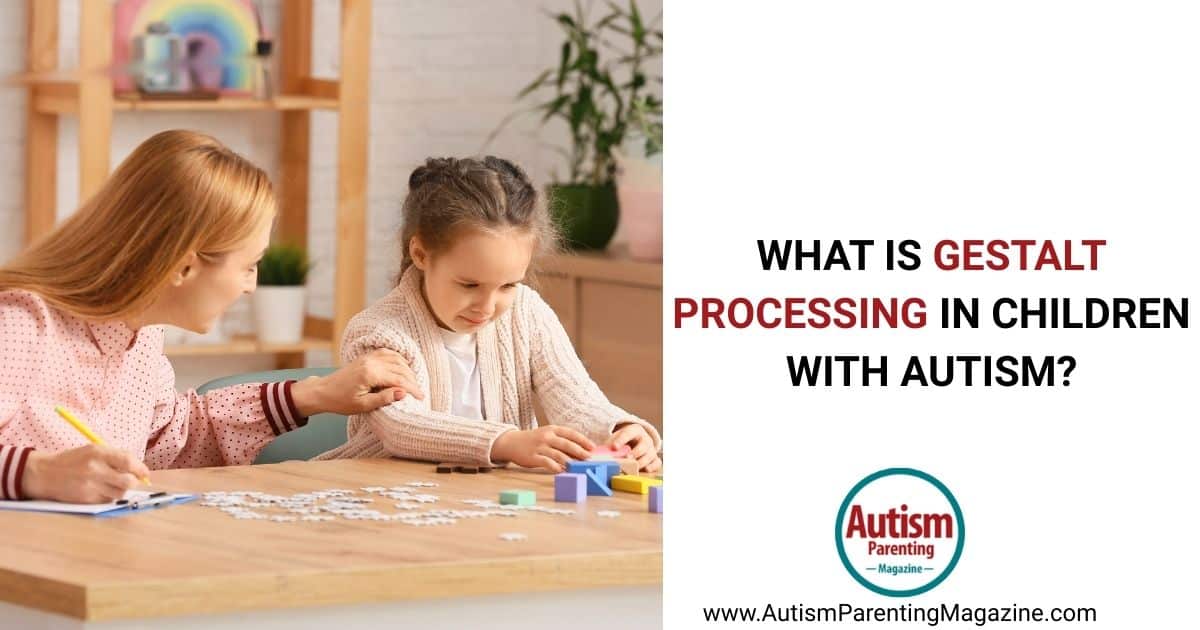
What’s Gestalt language processing (GLP) in kids with autism? For some, it’s a pure manner for them to develop speech, but it’s usually misunderstood.
Understanding Gestalt language processing
A toddler who’s a Gestalt language learner might purchase language in chunks reasonably than studying one phrase at a time. Dad and mom could also be instructed their youngster is simply “repeating phrases with out that means,” however analysis has proven that scripting and echolalia are important stepping stones towards significant communication.
The important thing to unlocking a baby’s language just isn’t stopping scripts however understanding and shaping them into practical speech.
How do Gestalt language learners develop communication in another way? What’s the emotional connection behind their scripts, and may working with a specialised therapist rework film quotes into significant conversations?
Gestalt vs. analytic language processing: Two completely different paths to speech
Most neurotypical kids are analytic language processors, studying phrases individually after which stringing them collectively into sentences.
Instance: “canine” → “huge canine” → “I see a giant canine.”
In distinction, Gestalt language processors, together with some autistic people, be taught language in pre-formed chunks.
Instance: “I see a giant canine” is realized as an entire unit reasonably than as separate phrases.
Research on Pure Language Acquisition emphasize that Gestalt language processing just isn’t a speech delay, however a basically completely different manner of buying language.
As an alternative of beginning with single phrases, these kids memorize complete phrases, usually from media, books, or previous experiences, earlier than they’ll break them down into versatile language.
You will need to notice that GLP just isn’t a dysfunction or a analysis.
Why does my youngster use film quotes as a substitute of their very own phrases?
Probably the most recognizable function of Gestalt language processing is echolalia, or the repetition of heard speech. Whereas echolalia was as soon as thought-about meaningless, trendy analysis has confirmed that echolalia serves a robust communicative perform.
For Gestalt learners, scripts should not random however usually tied to deep emotional that means. A toddler might say:
- “We’re blasting off!” once they’re excited to go exterior.
- “No extra monkeys leaping on the mattress!” once they don’t wish to do one thing.
- “I don’t prefer it, I don’t prefer it!” once they’re distressed.
These scripts categorical feelings, wants, or needs, however they aren’t but versatile. The kid doesn’t know the right way to extract particular person phrases to create new sentences. That is the place specialised remedy may make a distinction.
How can we assist a Gestalt language learner?
The aim is to not remove scripting however to assist kids transfer from repeating mounted phrases to producing their very own versatile language. In line with analysis research, Gestalt language learners transfer via 4 phases:
- Echolalic phrases (scripts): Utilizing full, memorized chunks of speech. (“Are you able to rumble?” as a substitute of “Let’s play.”)
- Mixing & modifying phrases: Combining items of various scripts. (“Are you able to go exterior?”)
- Single phrases & brief phrases: Breaking down scripts into particular person phrases. (“Prepared? Exterior?”)
- Self-generated language: Forming authentic, spontaneous sentences. (“Let’s go exterior and play!”)
Progressing via these phases requires an strategy that values their studying type and builds communication naturally.
The function of emotional connection in Gestalt language studying
One of the crucial missed elements of GLP is the emotional connection kids have with their scripts. Many autistic kids use favourite strains to self-soothe, categorical pleasure, or recall a comforting second.
Analysis reveals that Gestalt learners depend upon acquainted intonations and expressions as a result of they maintain emotional that means. For instance:
- A toddler combating a transition might say, “It’s time for an journey!” as a result of they affiliate it with pleasure.
- A toddler who’s lacking their father or mother might repeat “I’ll be proper again,” a phrase they as soon as heard their mother say earlier than leaving.
Fairly than discouraging scripting, mother and father and therapists ought to view these moments as alternatives to attach.
Do you want a Gestalt language therapist?
Conventional speech remedy usually focuses on single-word studying, which doesn’t align with how Gestalt language learners purchase speech. Some autistic kids labeled as “nonverbal” might have a wealthy inside language. A therapist educated in Pure Language Acquisition (NLA) may be capable to assist them break down their gestalts.
A educated Gestalt language therapist will:
- Acknowledge scripts as significant communication.
- Establish the emotional intent behind echolalic phrases.
- Mannequin brief, practical phrases that match the kid’s scripts.
- Assist them break chunks into versatile, spontaneous speech.
A current examine discovered that kids who obtained Pure Language Acquisition (NLA) remedy confirmed a lot higher enhancements in communication than those that obtained conventional speech remedy.
In case your youngster makes use of film quotes however struggles with dialog, discovering a therapist educated in NLA may make all of the distinction.
Sensible suggestions for folks
Right here’s how one can help a Gestalt language learner at dwelling:
Acknowledge their scripts and discover the that means
In case your youngster says, “It’s a good looking day within the neighborhood!” each morning, they could be expressing happiness.
Reply with “Sure! Good morning! You’re comfortable in the present day.”
Mannequin practical, brief phrases
As an alternative of asking, “Would you like a snack?”, mannequin “Need snack?” “Extra crackers?”
Broaden and modify their gestalts
In case your youngster says, “No extra monkeys leaping on the mattress!” once they don’t need one thing, reframe it: “No extra operating? Okay, let’s stroll.”
Have fun any progress
Each new phrase or mixture is a milestone. Encourage persistence, connection, and understanding. Gestalt language studying is a special manner kids make sense of language.
By working with a educated Gestalt language therapist, recognizing the emotional that means behind scripts, and modeling new language successfully, we might help our youngsters progress from memorized phrases to significant conversations.
The subsequent time your youngster excitedly shouts, “To infinity and past!” pause and hear. They may be telling you, “I’m so comfortable to be right here with you.”
FAQs
Q: Why doesn’t my youngster use their very own phrases?
A: Some kids be taught language in phrases as a substitute of single phrases. These kids are known as Gestalt Language Learners. They first repeat what they hear, and over time, they learn to flip these phrases into their very own phrases.
Q: Is my youngster speaking once they repeat film quotes?
Q: How can I ask my youngster a query if they’re a Gestalt language learner?
References
Blanc, M. (2012). Pure language acquisition on the autism spectrum: The journey from echolalia to self-generated language. Communication Improvement Heart. https://www.amazon.com/Pure-Language-Acquisition-Autism-Spectrum/dp/0615696104
Blanc, M., Blackwell, A., & Elias, P. (2023). Utilizing the Pure Language Acquisition protocol to help Gestalt language improvement. Views of the ASHA Particular Curiosity Teams, 8(6), 1279–1286. https://doi.org/10.1044/2023_PERSP-23-00098
Peters, A. M. (1983). The models of language acquisition. Cambridge College Press. https://communicationdevelopmentcenter.com/wp-content/uploads/2022/09/Models-of-Language-Acquisition.pdf
Prizant, B. M. (2016). Uniquely human: A special manner of seeing autism. Simon & Schuster. https://www.amazon.com/Uniquely-Human-Completely different-Seeing-Autism/dp/1476776245
Prizant, B. M., Wetherby, A. M., Rubin, E., & Laurent, A. C. (2003). The SCERTS mannequin: A transactional, family-centered strategy to enhancing communication and socioemotional talents of youngsters with autism spectrum dysfunction. Infants & Younger Youngsters, 16(4), 296-316. https://scerts.com/wp-content/uploads/SCERTS-Mannequin-article-in-IYC-2003.pdf